News and Press
Southern land-grant universities strengthen rural connections
Posted on May 04, 2026 at 16:43 PM
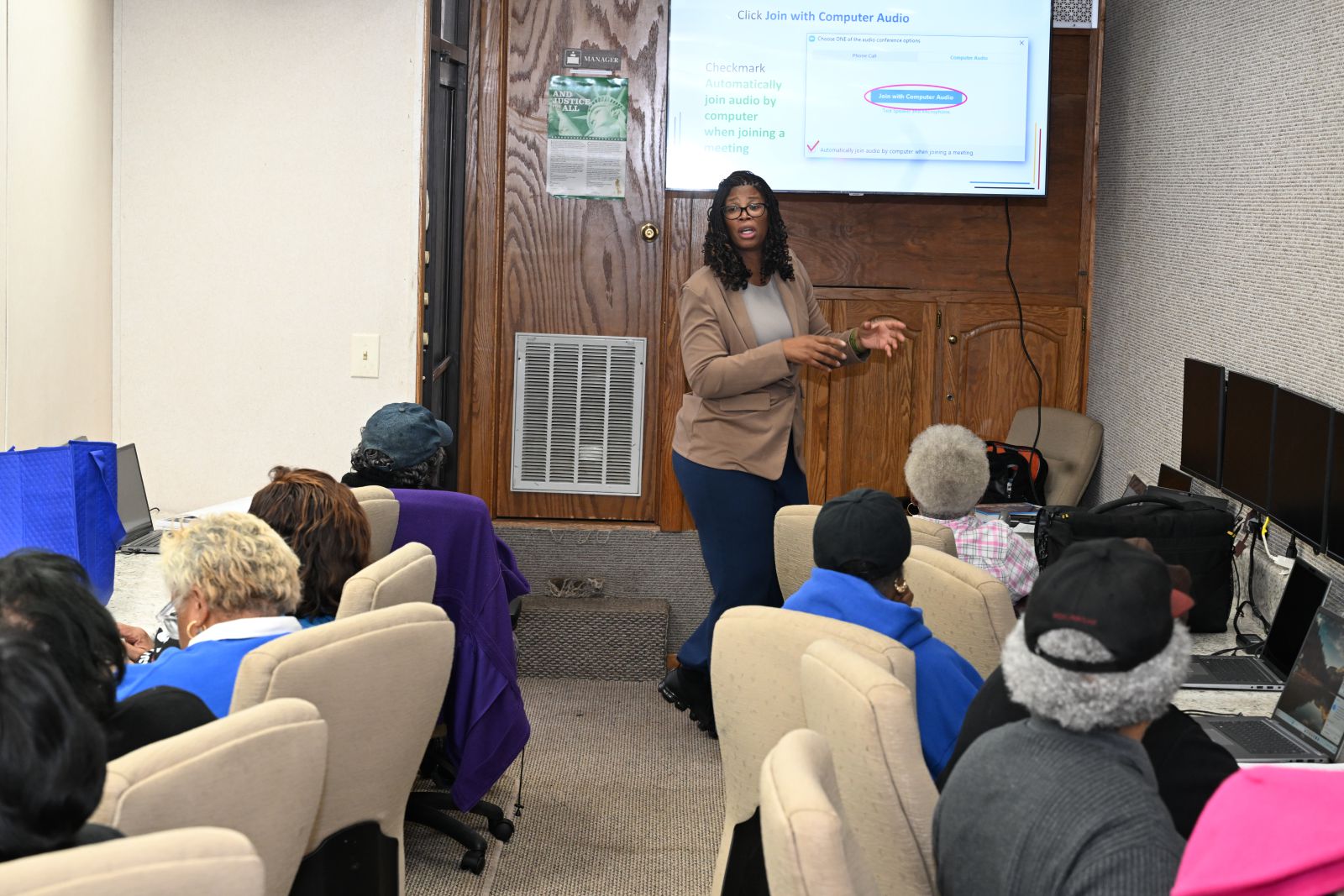
Yolanda McFerrin, Ed.D., technology curriculum specialist with Fort Valley State University Cooperative Extension, teaches computer skills for older adults in FVSU’s Mobile Information Technology Center.
Land-grant universities across the South are addressing the growing demand for digital connectivity in rural areas by leading research-based efforts to expand broadband, strengthen digital skills and connect communities to essential services.
By leveraging Cooperative Extension networks and agricultural research, these universities are helping rural communities stay connected, competitive and prepared for the future.
In Georgia, Fort Valley State University is bridging the digital divide in rural communities by addressing the critical need for broadband access and digital literacy as foundational elements of economic growth, education and social connectivity.
The initiative began with a data-driven analysis of digital connectivity in counties surrounding FVSU. Researchers identified significant gaps in broadband access and digital skills, particularly in areas with high poverty rates, aging populations and limited educational attainment.
FVSU Cooperative Extension secured funding from the U.S. Department of Commerce’s National Telecommunications and Information Administration through the Connecting Minority Communities grant, along with support from the Southern Rural Development Center. These funds enabled the deployment of wireless infrastructure and the distribution of technology in areas with limited resources.
FVSU also developed customized digital literacy programs with training that included a six-hour Digital Literacy course and multi-day technology camps tailored for seniors, working adults and young people. These sessions enhanced technical skills, confidence and cyber safety awareness.
The initiative fosters resilience through digital empowerment. Early results show increased online engagement and improved access to essential services, with residents reporting greater confidence navigating digital environments safely.
The University of Georgia’s College of Agricultural and Environmental Sciences offers students from rural communities access to a world-class agricultural education without leaving home.
The Hancock family is a prime example of this educational journey. Beginning with the Young Scholars Internship Program, each of the three Hancock brothers is building a transformative career. Guy Hancock earned a bachelor’s degree in agricultural and applied economics from UGA’s Athens campus and a master’s degree from the UGA Tifton campus. Now an agricultural data scientist and UGA Cooperative Extension specialist, he works on the campus that launched his path.
Ben Hancock, who earned a CAES bachelor’s degree in agribusiness, used his experience at UGA-Tifton and the Young Scholars Program to become a practicing attorney in his hometown. Jarrett Hancock, an agriscience and environmental systems major with a focus on precision agriculture, continues the family legacy while serving as a CAES Ambassador.
To build on these successes, the Transfer Pathways Program allows students from rural technical colleges to begin their education close to home before completing their UGA degrees at the Tifton, Athens or Griffin campuses. This initiative expands access and supports Georgia’s agricultural workforce needs in high-demand fields like precision agriculture.
In Louisiana, the Southern University Ag Center’s Cooperative Extension Program’s Mobile Technology Center (M-TEC) is bridging the digital divide in Louisiana’s urban and rural communities.
M-TEC provides internet access and educational resources to some of the most remote areas of the state. It is equipped with touchscreen monitors, laptops, a central processing unit and satellite systems, which enable it to serve as a mobile classroom for onsite trainings. The core mission of the unit is to improve access to education and resources in times of crisis, and it has been instrumental in disaster recovery efforts, serving as a mobile hub for vital information.
The unit also supports the Ag Center’s CEP community outreach initiatives, such as the JagFresh Farmers Markets, the Small Farmer Produce Giveaway in food deserts, the Rural Connections for Rural Resilience free virtual mental health program and the center’s Agricultural Certification Programs.
The Oklahoma State University Department of Agricultural Economics has focused on the value of broadband connectivity to rural communities. It is partnering with 30 libraries in small, rural communities (with populations of 2,500-7,000) across Oklahoma to provide mobile handheld devices that use cellular networks to offer broadband connections for library customers to take home or on the road. These internet hotspots can support up to 10 devices at a time for households lacking a regular internet connection.
OSU’s Brian Whitacre, Jean and Patsy Neustadt Chair in Agricultural Economics and OSU Extension rural development specialist, was appointed by the state Senate in 2020 to serve on the Oklahoma Rural Broadband Expansion Council, where he currently serves as chair. Oklahoma set up a state Broadband Office that has now distributed more than $450 million in grants to provide connectivity for more than 65,000 households or businesses. Another $750 million will soon be provided to connect the remaining 75,000 households that still lack high-speed internet. The goal of the council is to get all the 1.7 million households across the state access to the internet.
According to 2024 studies conducted by Whitacre, these faster connections could mean an increase in housing values between 2% and 9%, with speed improvements beyond 100 Mbps/20 Mbps, resulting in new business births. Whitacre also led the effort to install telehealth booths at three rural libraries across the state, where patrons can connect to a physician, often a specialist not available in rural locations.
Extension programs at Langston University in Oklahoma are leading a coordinated effort to expand high-speed internet access across 13 small towns across the state. These rural communities have long faced barriers to digital connectivity, limiting access to modern education, health care, business development and agricultural technologies.
By working together with local leaders, LU Extension has helped towns identify critical infrastructure needs, collect accurate service data and prepare competitive grant applications to secure broadband investment. This hands-on support will ensure that small communities often overlooked in statewide planning have a strong voice and proposals backed by real evidence of their needs.
Several towns have now been awarded funds, and broadband construction is already underway — a milestone that promises lasting economic and social benefits. Improved internet access supports economic growth, educational opportunities, health and wellness, agricultural innovation and government and community services.
The Oklahoma Broadband Office has worked closely with LU Extension to prioritize areas with limited resources and allocate critical resources. As a result, in Boley, Oklahoma, broadband installation is approximately 75% complete, marking a significant leap toward full digital access for residents and businesses.
Fort Valley State University, the University of Georgia, Southern University, Oklahoma State University and Langston University are part of a system of agricultural research centers at 1862 and 1890 land-grant universities across the southern U.S. Our scientists collaborate to conduct research and outreach focused on preserving the region’s natural resources and enhancing food production for a growing global population.
- Categories:
- FVSU Agriculture College
- Tags:
- Extension
- Research
Media Contact
- Latasha Ford
- fordl@fvsu.edu