News and Press
Fort Valley State hosts mental wellness workshop focused on farmers, rural communities
Posted on Jul 24, 2026 at 12:16 PM
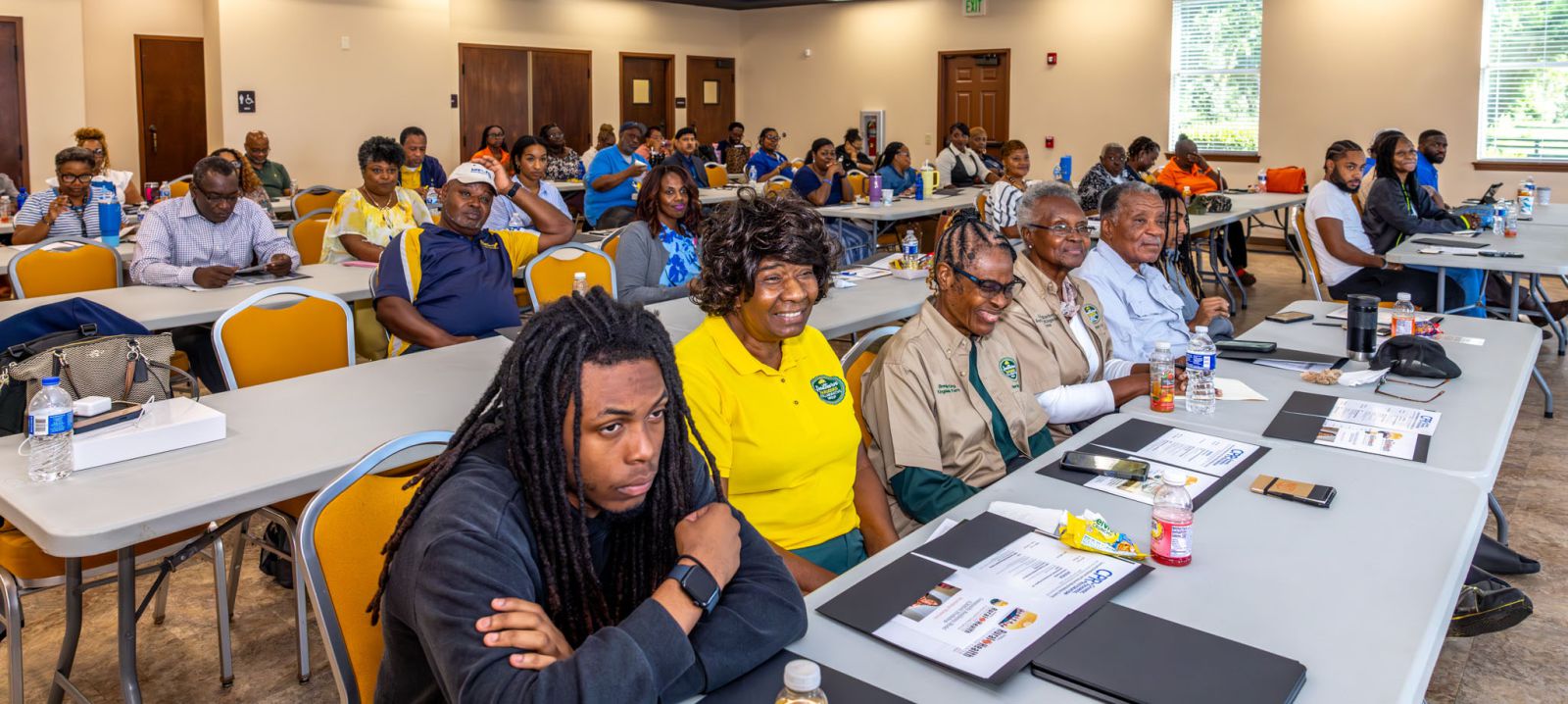
Farmers, rural residents and educational professionals listen to a presentation during the Change, Progress and Restoration workshop at Fort Valley State University on June 29.
Statistics from the Centers for Disease Control and Prevention show that suicide rates for farmers run 3.5% over the national average.
To facilitate open discussion and to inform farmers and rural residents about resources available to the agricultural community, Fort Valley State University’s Cooperative Extension Program, a member of the Georgia Agricultural Wellness Alliance, hosted a workshop called Change, Progress and Restoration (CPR) Community Development and Outreach Mental Wellness.
The event took place at FVSU’s Agricultural Technology Conference Center on June 29. More than 50 farmers, agricultural professionals, Head Start employees and rural residents attended the event.
The GAWA works to support agricultural communities and local partners by creating and identifying resources, training and conversations in support of better mental health on the farm. GAWA is supported through the Georgia Rural Health Innovation Center at Mercer University School of Medicine in Macon, Georgia.
John McElveen, Ed.D., director of GAWA, explained the importance of providing an avenue for farmers to address their concerns dealing with stressful situations.
“The purpose of this workshop is to build on the strength of the existing network Fort Valley State University Cooperative Extension has and the communities connected to it. This includes farmers integrated in Fort Valley State’s Extension program, as well as the Head Start programs it supports,” McElveen said.
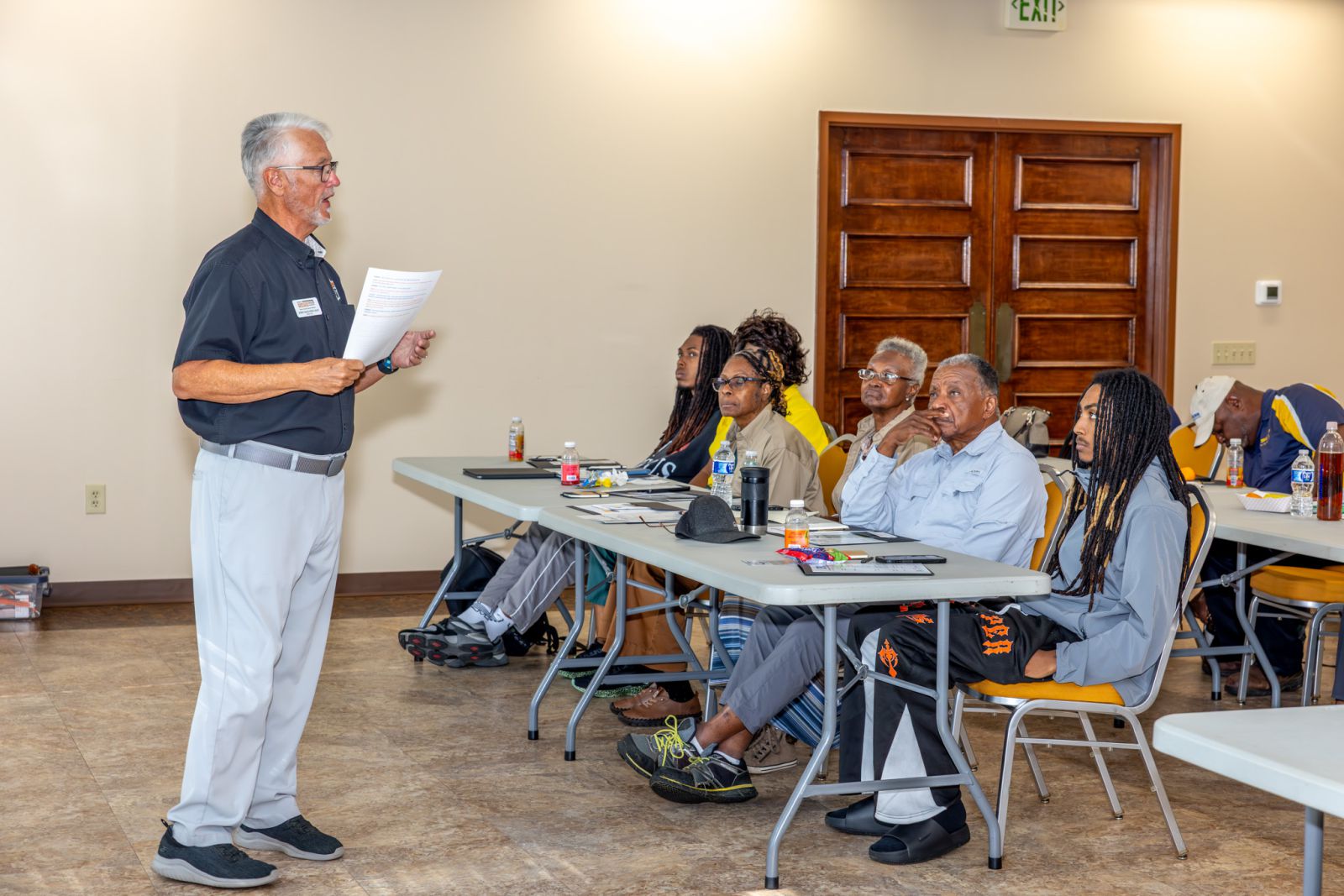
John McElveen, Ed.D., director of the Georgia Agricultural Wellness Alliance, addresses workshop attendees.
Furthermore, McElveen explained the need to include FVSU’s Head Start personnel to help them cope with situations concerning people’s mental well-being. He said that showing them how to effectively communicate with constituents or clients on mental health issues is extremely helpful.
“Sometimes what people consider to be uncomfortable conversations can be critical conversations to have when we’re worried about them,” McElveen said.
Additionally, McElveen said it is important that farmers and other agricultural professionals have peers as an outlet to discuss their mental health concerns.
“One of the best things about our farm communities is that nobody cares about their friends, neighbors and family more than they do. But they don’t often know how to have those conversations because they probably weren’t brought up to do so. To be able to talk about things like mental health as an actual health issue, which it is, is important because it can save somebody’s life,” McElveen said.
Brendia King, a farmer from Bainbridge, Georgia, was happy to attend a workshop focused on the mental stress of the profession.
“I am so glad that we (farmers) had this. Farmers need this kind of input and help. It’s good that they’re (FVSU) putting it out there and acknowledging that there is a need for this,” King said.
Furthermore, the South Georgia farmer said she would highly recommend to her peers that they seek help from FVSU’s Cooperative Extension Program in stressful situations.
“Reach out to Fort Valley State University because not only do they cover what is needed in farming, but they deal with the whole farmer. This includes mental stability, mental health and financial health,” King said.
She also added that farmers should help FVSU bring in more students so that they can train them on the latest farming techniques.
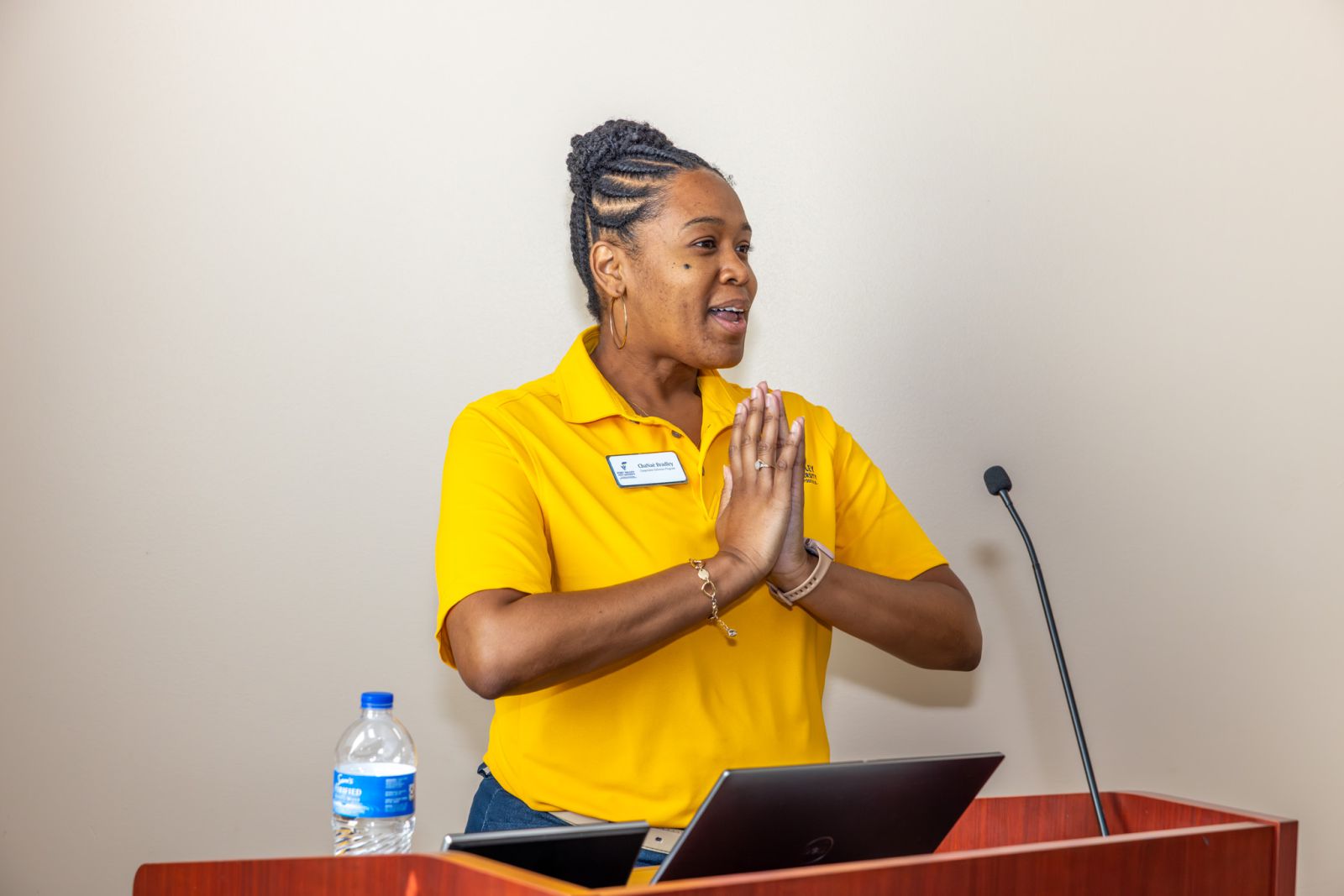
ChaNaè Bradley, Ph.D., assistant administrator for community development and outreach for FVSU Extension, provides remarks during the workshop.
ChaNaè Bradley, Ph.D., assistant administrator for community development and outreach for FVSU Extension, expressed how farmers can benefit from FVSU’s collaboration with GRHIC.
“It’s a good partnership because Mercer has a focus on rural health care and we in Extension have a focus on helping farmers and serving rural communities. By merging our audiences and expertise, we’re able to reach a specific group of clients with information that is geared toward their mental health and wellness,” Bradley said.
Moreover, Bradley said the workshop provided training tailored to farmers and workers in rural communities with examples and scenarios linked to their daily routines. She also said due to the limited access to therapists and counselors in rural areas, farmers were connected to resources available 24/7 regardless of location.
The workshop was funded through a Sustainable Agriculture Research and Education grant. The grant supports this training and funding for one FVSU student and one Mercer student to participate as paid summer research assistants. For the summer, the students will conduct field observations, assist with interviews and qualitative research, and develop surveys focused on farmer mental health education and evaluation in agricultural communities. To culminate their experiences, they will create a research poster.
For more information about FVSU Cooperative Extension and future programs, call (478) 825-6296.
- Categories:
- FVSU Agriculture College
- Tags:
- Extension
Media Contact
- Russell Boone
- Booner@fvsu.edu